
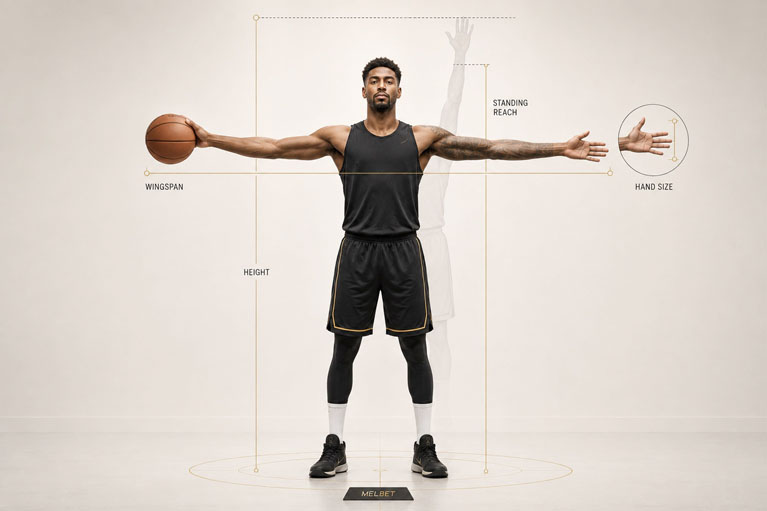
Height is the number printed beside almost every basketball player’s name. Scouts need much more. Two athletes listed at 6-foot-7 can defend different positions, reach different heights and cover very different amounts of space. Wingspan, standing reach, weight and hand size add detail that basic height cannot show. Professional evaluation therefore starts with a group of measurements rather than one impressive figure.
The same habit of reading numbers appears across digital entertainment, although the figures serve different purposes. Users often see limits, tables and rules before they choose an activity. When browsing online casino games, for example, bet sizes and game information help explain how a title works rather than predict what will happen next. Basketball measurements also need that kind of context. A long wingspan describes a physical tool, not an automatic result.
Height Still Sets the Basic Frame
Taller centers can contest shots near the rim without jumping as high. Bigger forwards may shoot over smaller defenders. Guards with extra size can see passing lanes that are harder for shorter players to use. None of this makes height sufficient on its own. Professional measurements are also more precise than a rounded roster listing. At the NBA Draft Combine, prospects are measured without shoes. A player described publicly as 6-foot-6 may therefore produce a slightly different official result. That distinction matters when clubs compare dozens of prospects. Small differences become more useful when combined with reach and movement data.
Wingspan Shows How Much Space a Player Can Cover
Scouts calculate wingspan by measuring extended arms from fingertip to fingertip. Comparing this reach against standing height highlights unusual physical proportions. A guard standing six feet five inches with longer arms plays larger than expected. Extra length aids in blocking shots, deflecting passes, and maneuvering around defensive screens.
The effect is especially visible on defense. Long arms can close part of the distance to a shooter before the feet arrive. They can also help a defender recover after being beaten by the first move. Still, length cannot replace timing or positioning. A player who reaches constantly may simply collect fouls.
Weight Means Different Things at Different Positions
Weight provides another part of the picture. A center needs enough strength to hold position against large opponents. A guard carrying too much mass may lose some speed, while an extremely light forward can struggle through contact. The useful number depends on the role. There is no ideal body weight for every basketball player.
Scouts also look at how mass is distributed and how the athlete moves with it. Two 220-pound players can have very different strength and mobility. Conditioning matters across an entire game. A powerful body has less value if performance drops sharply after several fast possessions.
Measurements Can Help Explain a Matchup
Physical dimensions become more useful when two specific teams meet. A long frontcourt may make scoring near the rim difficult. Smaller guards can still create an advantage if they are quicker and force switches. Rebounding can depend on reach and positioning rather than the listed height of one center. The numbers become tactical when they are connected with how teams actually play.
That context is also important for adults looking at PBA odds. Size differences can matter when one team lacks a regular big man or has trouble defending the paint. They should still be considered alongside injuries, recent form, rotations and playing style. A favorable wingspan comparison does not make a result certain. Any wager should use a fixed budget rather than one physical statistic.
Athletic Testing Adds Movement to the Numbers
A static body profile cannot show how quickly the athlete uses it. This is why professional combines include movement tests. The NBA evaluates vertical jumping, sprinting and agility alongside physical measurements. Players also complete shooting drills. Clubs then compare size with actual movement.
Common evaluation data includes:
- height without shoes;
- weight;
- wingspan;
- standing reach;
- hand length and width;
- vertical jump;
- sprint performance;
- agility results.
The value comes from combining these figures. A long athlete who also moves quickly offers a different profile from someone with similar dimensions but limited mobility.
Numbers Describe Tools, Not Outcomes
Scouting measurements are useful because they remove guesswork about physical dimensions. They do not remove uncertainty about performance. A player can have exceptional length and poor defensive awareness. Another may be undersized but anticipate every rotation. Skill and decision-making remain harder to measure with a tape.
The same distinction matters when numbers appear in other real-time entertainment. A live casino interface may show table limits, game rules and current session information before a user joins. Those figures explain conditions rather than forecast the next result. Basketball data should be read with the same discipline. Measurements tell us what physical tools an athlete possesses, not exactly what will happen when the game begins.
Position Changes the Meaning of Size
A 6-foot-8 player can be large for a guard and small for a center. That changes how scouts interpret every other measurement. Long arms on a point guard may create defensive versatility. The same wingspan on a big man might be ordinary. Physical data makes sense only after the likely role is considered.
Modern basketball complicates this further because positions overlap. Forwards handle the ball. Centers shoot from outside. Large guards defend several spots. Scouts therefore increasingly ask what a body allows a player to do rather than forcing every measurement into an old positional template.